
Guide: Soft yarn for scarves and scarves
How to choose the right one (and 4 delicious favourites)
Are you looking for soft yarn for scarves and scarves, that feels pleasant against the skin and gives a great result? When you're knitting something that needs to sit close to the neck, the choice of yarn makes a big difference - especially if you're sensitive to scratches. In this post, we take a closer look at what characterizes soft yarn for scarves, and you get four specific yarn proposals, which is perfect for both small scarves and larger shawls.
What makes yarn soft (and comfortable) for scarves?
When you choose soft yarn, the material is the most important place to start. Fibers like merino, cashmere, silk and baby alpaca are popular for scarves and scarves because they typically feel extra comfortable against the skin – and at the same time provide good warmth without necessarily feeling heavy.
But softness is not just about the fiber type. The fineness of the fibers and the way the yarn is spun also plays a big role:
-
The "grade" (fineness) of the fibers: Many fibers are available in different quality grades. The finer the fibers, the softer the yarn usually feels. A classic example is merino, where there can be a big difference fine and extra fine merino.
-
Spindle and surface: A yarn with a more even and dense spinning can feel smoother against the skin and give a calm mask image. A more airy yarn can feel extra light and give a soft, "puffy" feeling - really delicious for scarves.
-
Blend of fibers: Cashmere or silk in a mixture can lift the feeling significantly, while merino often contributes elasticity and shape stability, so that scarves and shawls keep their shape nicely.
-
Knitting strength and needle: The same yarn can be experienced differently depending on how loosely or tightly you knit. A slightly airier knit strength can give more fall and a softer feel, while a tighter knit gives a more classic, warm and "compact" scarf.
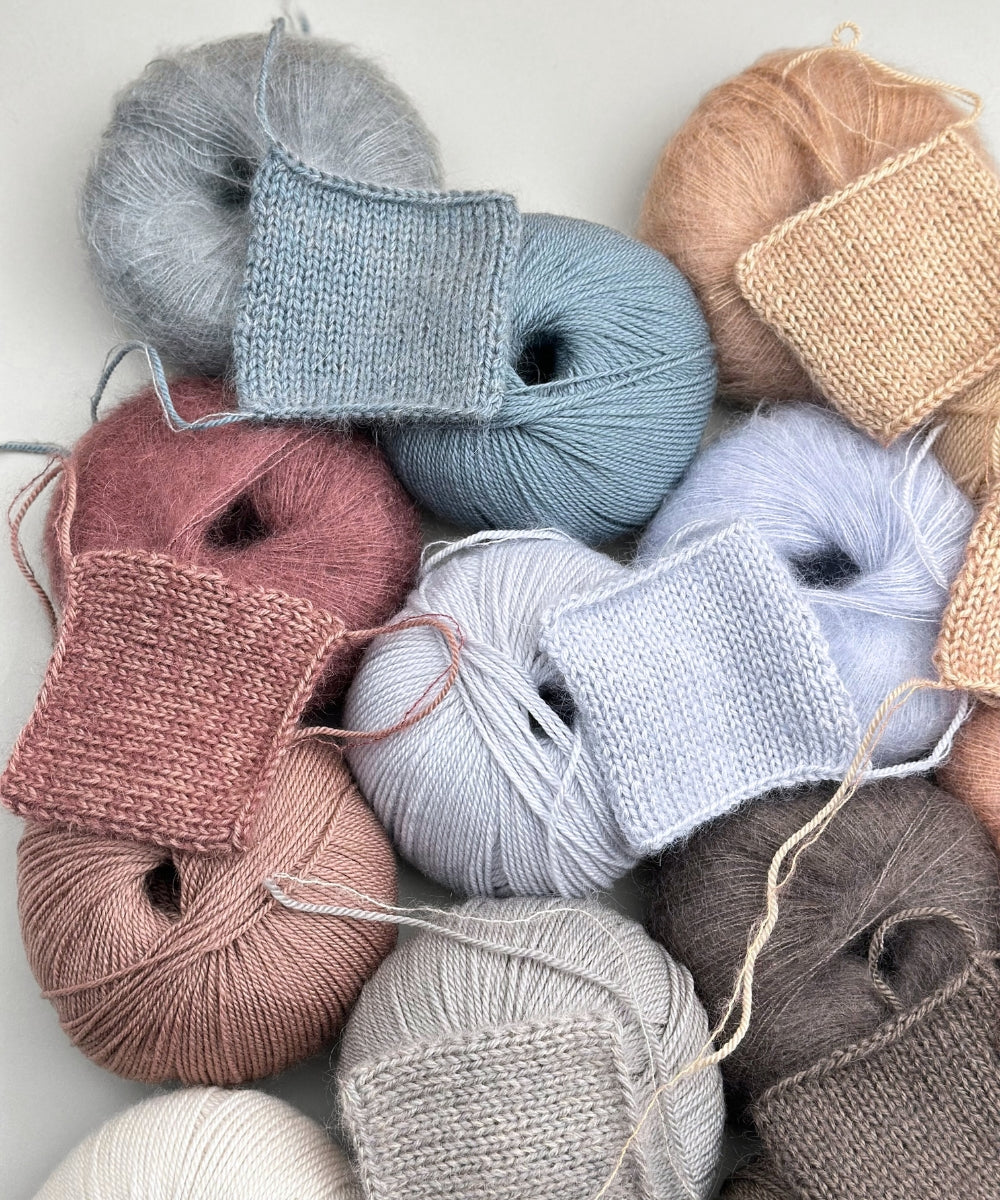
Below we have collected four selected yarn qualities, all of which are ultra soft and spun from fine fibers. They are particularly good for knitwear to be worn around the neck - both if you want to make a large, warm scarf or a small scarf that you can use every day. And we have made it easy to choose by showing specific examples of knitting in each yarn, so you can quickly find the quality that suits your next project.
Below we describe the following yarn qualities and show examples of scarves knitted in each suggestion:
- MAX VIP: Soft cashmere/merino yarn for warm scarves
- VIP: classic scarf look in ultra-soft quality
- Eco Soft Cashmere: 100% cashmere with luxury and vamp
- Baby Alpaca + Kimsa: scratch-free softness with light fluff
1) MAXI VIP: Soft cashmere/merino yarn for warm scarves

80% extrafine merino, 20% first cut cashmere • 50 g = 100 m • needle 4.5–5 mm
Maxi VIP is an obvious choice if you want to knit a scarf or scarf with a little more volume - without compromising on the feel against the skin. The one extra fine merino provides elasticity and a soft, warm base, while first cut cashmere gives it extra luxury: a smooth, comfortable surface and a softness that makes the yarn particularly suitable for knitwear to be worn close to the neck.
At the same time, Maxi VIP is a more budget-friendly alternative to pure cashmere, because you get a distinct cashmere feel and a delicious, luxurious result – without it costing the same as a 100% cashmere project. On needles 4.5–5 mm, you get a quick project with nice fullness and a delicious fall - perfect for warm scarves.
See the selection of Maxi VIP here.

1. Sophie Shawl by PetiteKnit (recipe here). Knitted in Maxi VIP fv. 14576. Consumption: 3 (5) 6 keys for size S (M) L
2. Lulu Shawl by Mette Sandgaard Kühl (recipe here). Knitted in Maxi VIP fv. 30480. Consumption: 5 keys
2) VIP: classic scarf look in ultra-soft quality

80% extrafine merino, 20% first cut cashmere • 50 g = 200 m • needle 3–3.5 mm
VIP has the same luxurious fiber combination as Maxi VIP, but is knitted on smaller needles and is half as thick. It is therefore suitable for small, fine scarves and shawls on smaller needles.
Extra fine merino contributes with shape stability and a soft "bounce", while first cut cashmere makes the yarn extra comfortable against the skin. VIP is also one budget-friendly alternative to 100% cashmere, where you still get the exclusive, soft feeling around the neck - just in a quality that is easier to knit many meters in. The result is a scarf that feels soft and nice, also for you who sensitive to scratches.
See the selection of VIP here.

1. Sophie Scarfe by PetiteKnit (recipe here). Knitted in VIP fv. A4947. Consumption: 1 key for both sizes
2. Thilde Shawl by Mette Sandgaard Kühl (recipe here). Knitted in VIP fv. 19004. Consumption: 1 key
3) Eco Soft Cashmere: 100% cashmere with luxury and vamp

100% cashmere (partly recycled) • 25 g = 125 m • needle 3.5 mm
Eco Soft Cashmere is for you who want the ultimate feeling of cashmere against the neck. The yarn is 100% cashmere and you can feel it: it is ultra-soft, light and warm – with a beautiful, more velvety character that gives scarves a luxurious and light look.
It is a popular choice for scarves and small shawls, because it is both comfortable to knit with and ultra-delicious to wear. At the same time, the natural properties of the cashmere fibers give a nice, calm mask image and an exclusive finish, which works really well in the small scarves that have to put the finishing touch on your outfit.
See the selection of Eco Soft Cashmere here.


1. Sophie Scarfe by PetiteKnit (recipe here). Knitted in Eco Soft Cashmere fv. 2751. Consumption: 1 (2) keys for size small (large)
2. Scarf No. 4 (recipe here) and Gloves No. 1 (recipe here) by My Favorite Things Knitwear. Knitted in Eco Soft Cashmere fv. 2751. Consumption: 2 keys for scarf and 2 keys for gloves
3. Lulu Scarf by Mette Sandgaard Kühl (recipe here). Knitted in Eco Soft Cashmere fv. 6357. Consumption: 3 keys
3. Irma Scarf by Butik Smuksak (recipe here). Knitted in Eco Soft Cashmere fv. 2747. Consumption: 2 keys
4) Baby Alpaca + Kimsa: scratch-free softness with light fluff

Baby Alpaca: 100% baby alpaca • 25 g = 200 m
Kimsa: 54% baby alpaca, 22% super kid mohair, 24% mulberry silk • 25 g = 200 m
Knit together on needles 3.5–4 mm
Do you want a scarf that feels ultra-soft, warm and completely scratch-free, the combination of Baby Alpaca and Kimsa is a really delicious solution. Baby Alpaca is spun from the finest alpaca fiber, which is typically used for hand knitting - and this gives a yarn that is remarkably soft and comfortable at the neck.
When you knit Baby Alpaca together with Kimsa, you get a light "veil" and a velvety, soft surface at the same time. Kimsa is a good alternative to classic silk mohair, especially if you are scratchy: baby alpaca + silk gives softness and fall, while super kid mohair contributes with the airy fullness - without the result feeling sharp against the skin.
See the selection of Baby Alpaca here and see the selection of Kimsa here.

1. Sophie Scarfe by PetiteKnit (recipe here). Knitted in Baby Alpaca fv. SFN61 + Kimsa fv. 4330. Consumption: 1 key of each for both sizes.
2. Beautiful Scarf by Butik Smuksak (knitting kit here). Knitted in fv. Camel. Consumption: 1 key of each